

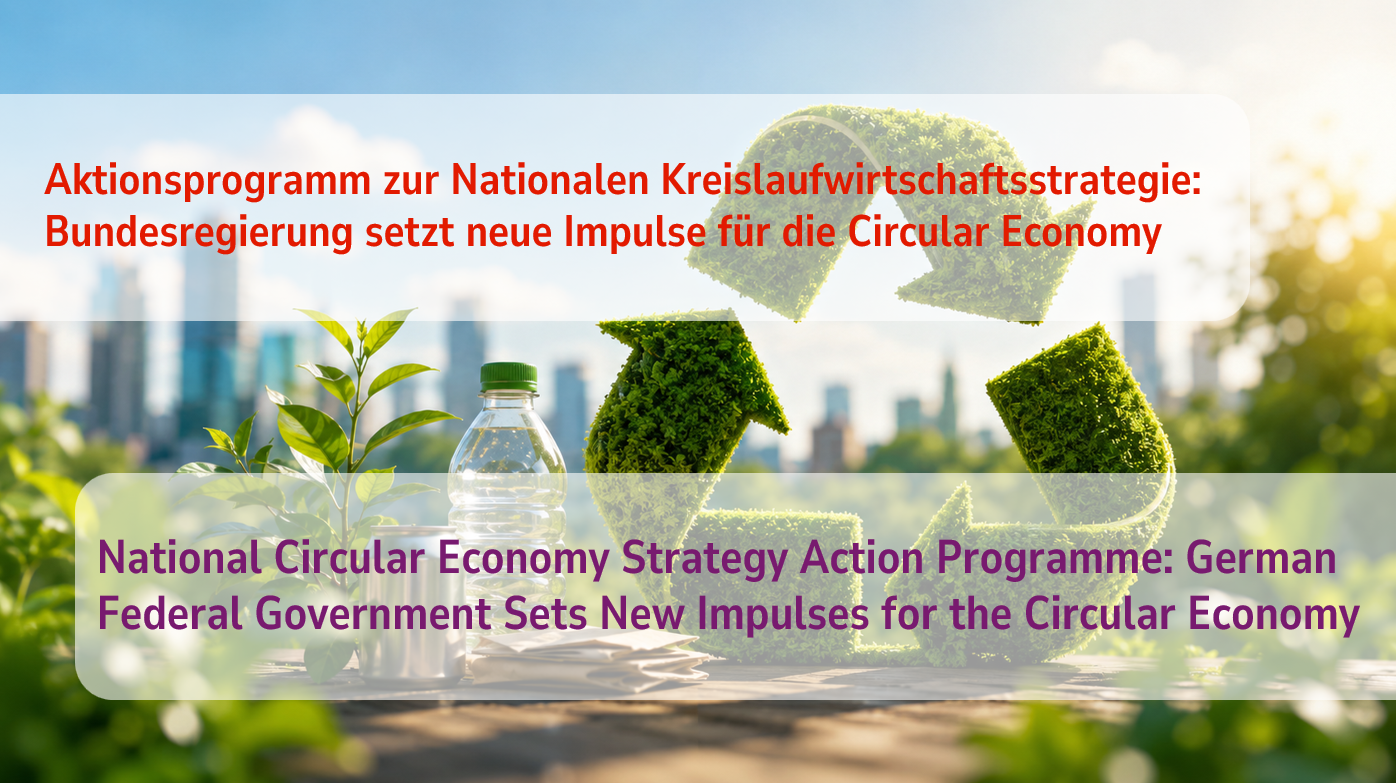
09 June 2026 – At the beginning of June 2026, the German Federal Government presented its Action Programme for implementing the National Circular Economy Strategy (NKWS). Through twelve priority measures, the circular economy in Germany is to be systematically strengthened by the end of 2027. The objective is to keep raw materials in circulation for longer, improve security of supply, enhance economic competitiveness, and make a significant contribution to climate protection and resource conservation.
Circular Economy as a Key to Competitiveness and Supply Security
In light of global raw material shortages, geopolitical uncertainties, and increasing demands for sustainable business practices, the German Federal Government considers the circular economy a central pillar for the future of Germany as a business location. Through resource efficiency and closed material loops, companies can reduce their dependence on primary raw materials while simultaneously lowering costs and greenhouse gas emissions. According to a recent study, up to 80 million tonnes of additional CO₂ equivalents could be saved by 2030.
More Investment and Innovation for the Circular Economy
A key focus of the Action Programme is the promotion of innovative technologies and business models. Approximately €260 million will be made available through the new “Future Circular Economy” funding programme. Supported projects include pilot facilities, recycling technologies for batteries, photovoltaic modules and wind turbines, as well as digital solutions for circular value chains. An additional €305 million is planned for further investment funding between 2027 and 2030.
Digitalisation as a Driver of Closed Material Loops
The Federal Government is also planning a comprehensive digitalisation initiative for the circular economy. Key elements include the Digital Product Passport, AI-supported applications, and the development of a Circular Economy Information Ecosystem (CEIS). These measures are intended to increase transparency in material flows, improve process efficiency, and enable new business models.
Public Procurement to Serve as a Role Model
With its substantial purchasing power, the public sector aims to create stronger incentives for the use of recycled materials and circular products in the future. At the same time, greater emphasis will be placed on the reuse, repair and refurbishment of products. Secondary raw materials are also expected to play an increasingly important role in the construction sector.
Extended Producer Responsibility to Be Expanded
Particularly relevant for the packaging industry: Germany’s national packaging legislation is to be aligned with the new European Packaging and Packaging Waste Regulation (PPWR) by August 2026. In addition, the Federal Government is planning improvements to Extended Producer Responsibility (EPR) schemes and the introduction of corresponding regulations for textiles.
Furthermore, the Federal Government is advocating for the recycled content targets for plastic packaging stipulated in the PPWR to have an impact before their official implementation date in 2030. A so-called “accumulation phase” is planned for 2028 and 2029, allowing recycled plastics used during this period to be counted towards future recycled content targets.
What This Means for Businesses
The Action Programme clearly demonstrates that the circular economy will continue to gain importance in the coming years. Companies should prepare early for upcoming requirements while taking advantage of the opportunities arising from digitalisation, recycling, the use of recycled content, and innovative business models.
For manufacturers, distributors, and packaging producers, the upcoming changes to packaging legislation, the growing importance of recycled content, and increasing digitalisation across supply and value chains will be particularly relevant.
Download the NKWS Action Programme (PDF) here.
About EKO-PUNKT
EKO-PUNKT, the dual system operated by REMONDIS, already supports companies in meeting key circular economy requirements. With PackLab Pro, EKO-PUNKT offers a digital compliance and packaging management solution that helps companies capture, analyse and manage packaging data while supporting seamless documentation and the preparation of declarations of conformity.
Try PackLab Pro free of charge today
In addition, EKO-PUNKT supports companies in developing circular packaging solutions through consulting services focused on eco-design, packaging optimisation and resource efficiency. EKO-PUNKT also provides practical support for the use of recycled plastics – from sourcing suitable recyclates to integrating recycled materials into existing packaging solutions. This enables companies to meet regulatory requirements, achieve their sustainability goals and strengthen their competitiveness.
Book your consultation appointment today
Autor
EKO-PUNKT GmbH & Co. KG
Vanessa Herzog
Waltherstr. 49–51
51069 Cologne, Germany
T +49 221 964897-62
M +49 160 6184350
vanessa.herzog@eko-punkt.de
Image credit: AI-generated with OpenAI.
Source: Aktionsprogramm NKWS